





Brian Tang: The costs of living weather blind
This essay was written by Professor Brian Tang of the Department of Atmospheric & Environmental Sciences and first appeared in UAlbany's 2026 research magazine.
Before you head out in the morning, do you check your weather app to see if you need a coat or umbrella?
Having an accurate weather forecast at your fingertips is something we take for granted, but it wouldn’t be possible without the stream of publicly available weather data and advances in weather research.
For decades, this country has wisely invested in the pieces needed to improve forecasts — collecting observations, performing research and developing more capable computer models. Much of this work is performed and funded through government agencies like the National Oceanic and Atmospheric Administration (NOAA) and the National Science Foundation (NSF). Given the danger of living weather blind, this investment has long had bipartisan support.
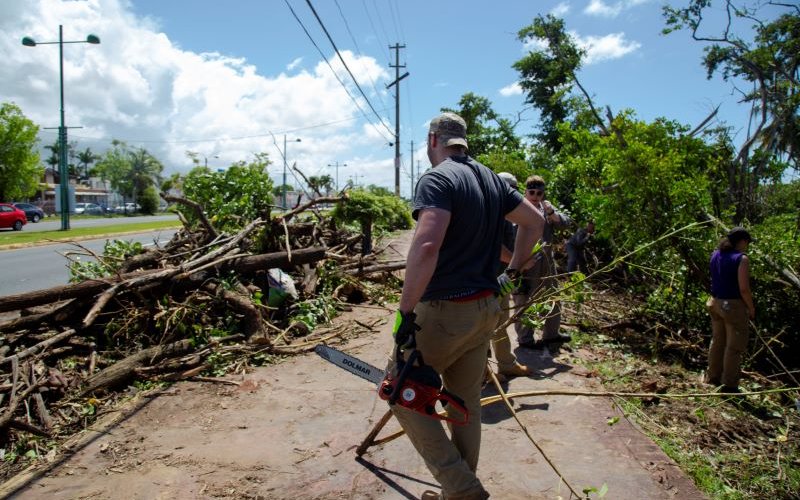
In a 2025 NOAA report to Congress, the National Weather Service was credited with providing more than $100 billion in economic benefit each year, a whopping 70x return on investment. Improvements to hurricane forecasts alone have resulted in $5 billion in savings per hurricane and untold lives spared.
These successes are a team effort. For example, scientists at the NSF-funded National Center for Atmospheric Research (NCAR) developed the GPS dropsonde, the device released into hurricanes to gather real-time data on temperature, wind speed and pressure. NOAA scientists routinely fly into hurricanes to release these devices, and the data are then ingested into NOAA computer models to forecast hurricane track and intensity and then used by emergency managers to protect their communities.
UAlbany scientists funded by NSF and NOAA grants have used this data to better understand hurricanes, such as a recent study assessing the impact these dropsondes have on hurricane track forecasts. My own work has used this data to gain deeper insight into what causes hurricanes to rapidly change in intensity, which can be especially challenging to predict.
Similar partnerships have been foundational to U.S. leadership in science, improving our quality of life and fueling our economic prosperity.
Over the last year, it has been alarming to see the federal government divest from this work, weakening the science that helps us know our planet and use that knowledge to stay safe. Staff departures have hurt the National Weather Service’s ability to carry out basic functions like launching weather balloons. Retired NOAA scientists have volunteered to staff hurricane reconnaissance missions. And now the federal government has announced its intention to “dismantle” NCAR, which would leave a gaping hole in atmospheric science research and education.
There is only so much stress a system can take before it breaks.
These federal cuts threaten to halt progress on the next generation of weather radar technologies, computer models and artificial intelligence tools. Admirably, many federal scientists are staying the course, despite the stress, because they are dedicated to advancing science in the service of society.
I am reminded of an image of a beach house on a barrier island standing tall on stilts as a hurricane rages around it. It takes a beating until the wind and storm surge become too much, then suddenly and spectacularly collapses into the surf.
There is only so much stress a system can take before it breaks. My fear is that we are stressing the pillars of our weather research and warning infrastructure near their limits and that a break will occur during a critical moment. A radar will be in disrepair during a tornado outbreak or a river gauge will not be operating during a flash flood. Crucial minutes will go by without warnings, resulting in needless loss of life, suffering or economic ruin. It is difficult to know when a failure might occur, but the risk grows as these important institutions remain in a continuous state of triage.
Against the backdrop of a growing global population on a warming planet, the stakes could not be higher. We cannot lower our defenses and surrender the progress we have made so diligently. We must advocate for the funding and staff needed to keep these pillars from eroding further. More than your weather app depends on it.
Brian Tang's research on tropical cyclones has been supported by federal funding.